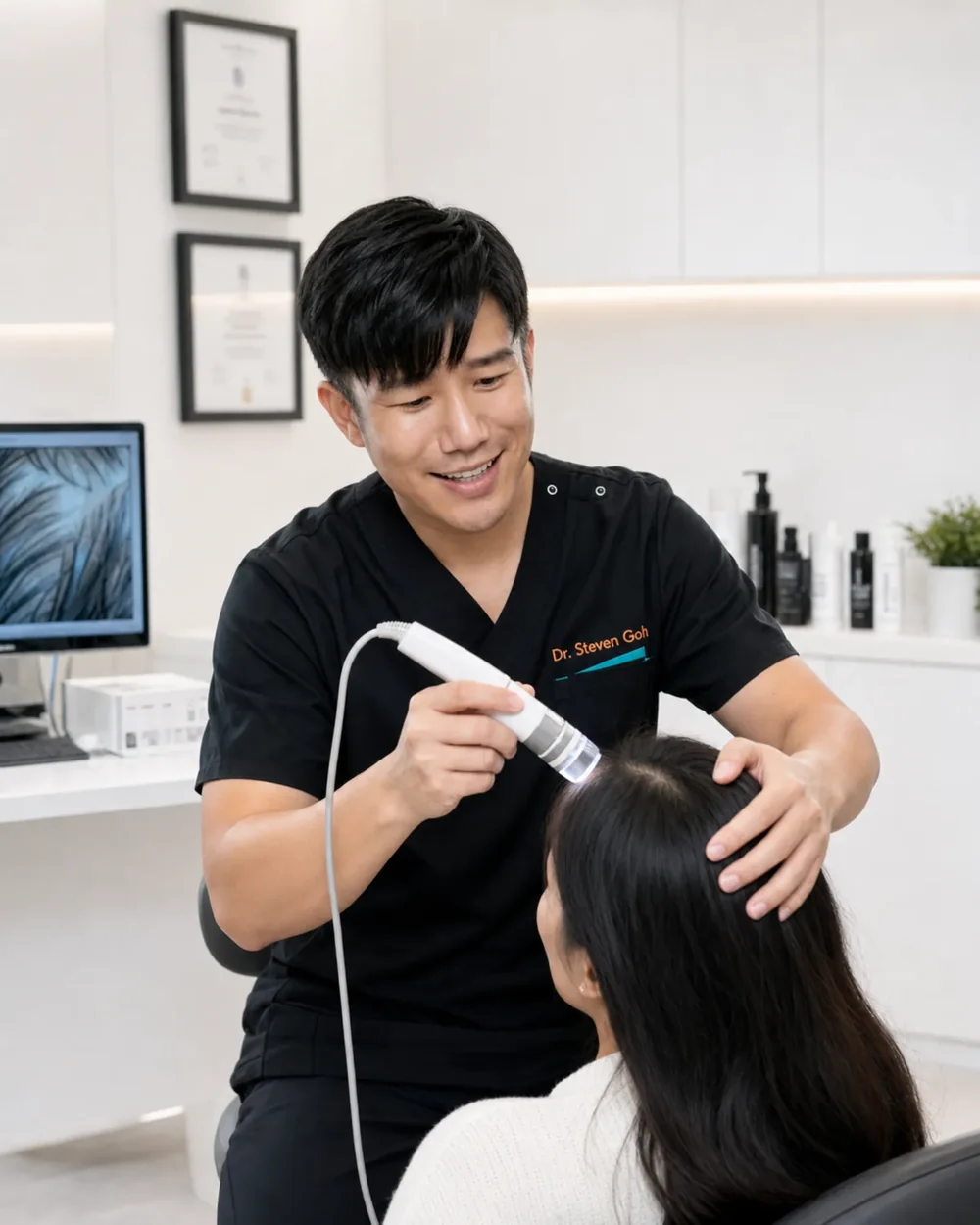
Research on red and low-level light in hair loss is real but limited: studies used particular devices, wavelengths and schedules, results varied, and many were small or industry-funded. It is reasonable to call it a studied approach; it is not reasonable to say any light programme is proven for everyone.
What the studies show
Systematic reviews of hair-loss treatments include low-level light among studied options, with some trials reporting improvements in hair counts using specific devices. Others found smaller or unclear effects.
What they don't show
They do not show results for spa or centre programmes that include a light step, including ours. They also do not tell you how long any change lasts after stopping.
How to read claims online
Be wary of exact numbers, before/after photos in different lighting, and claims that light alone fixes hair loss. Ask which study, which device, and who funded it.
Questions
Is red light the same as UV?
No. Visible red light is not ultraviolet.
Does more light mean better results?
Not necessarily. Studies used set doses; more is not automatically better.
Studies mentioned
These studies looked at ingredients or general approaches. None of them tested our treatments or products, so they are background, not proof.
- Perez SM et al. Low-Level Laser and LED Therapy in Alopecia: A Systematic Review and Meta-Analysis. Dermatol Surg 2025.Systematic review and meta-analysis. Pools studies of low-level laser and LED devices in hair loss and notes that device settings and study quality vary widely.PubMed 39404126doi:10.1097/DSS.0000000000004442
- Adil A, Godwin M. The effectiveness of treatments for androgenetic alopecia: a systematic review and meta-analysis. J Am Acad Dermatol 2017;77(1):136-141.Meta-analysis. Pooled trials found several approaches, including low-level light, did better than placebo for hair count. Trial quality was mixed.PubMed 28396101doi:10.1016/j.jaad.2017.02.054