EN中文BM
Folli Series · Scalp foam · Men & women

Folli-Fix

A light, fast-drying foam for daily use on the scalp, for men and women. Made with minoxidil plus ginger and lemongrass extracts. One 80ml bottle is about a month’s supply.

  • Foam · 80ml
  • About a 1-month supply
  • Men & women 18+

Price RM149 · 3 for RM447, free shipping

Shipping in Malaysia: RM20 West, RM30 East, added at checkout. Bundles of 3 ship free. Malaysia delivery only, no overseas orders.

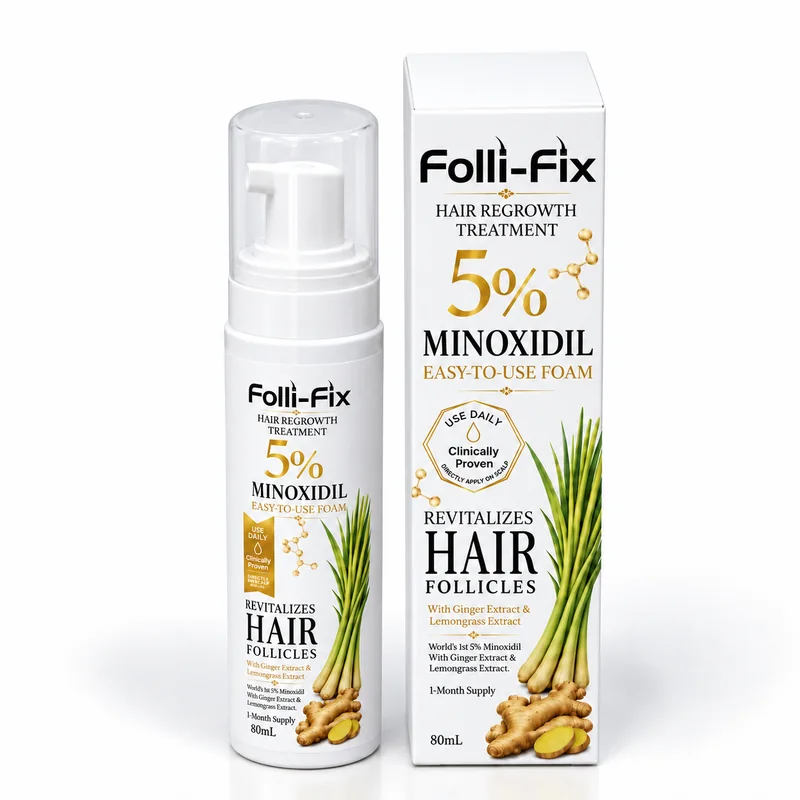
Folli-Fix foam bottle and box, front view
001

What it is

Folli-Fix is a topical scalp foam built around minoxidil, the hair-loss active with the longest clinical track record in topical use.

In randomised, placebo-controlled trials it has consistently outperformed placebo for hair growth in men and in women [1].

Folli-Fix delivers minoxidil as a light, fast-drying foam designed for the scalp rather than the hair lengths, so it spreads thinly, absorbs cleanly and sits comfortably under your styling routine. A botanical complex of ginger and lemongrass extracts completes the formula as scalp-care support.

One 80 ml bottle lasts about a month at labelled use. Folli-Fix is unisex, and it is the usual starting point for women and for anyone new to minoxidil.

002

Who it’s for

Good for

  • Adult men and women (18+) noticing gradual thinning on the top or crown of the head, or a widening parting.
  • Women and first-time minoxidil users, who usually start with the foam.
  • Anyone who prefers a light foam that dries quickly and doesn't feel greasy.

Not for

  • Anyone under 18.
  • Anyone who is pregnant, planning a pregnancy or breastfeeding.
  • Sudden, patchy or unexplained hair loss: see a doctor first, as it needs a diagnosis.
  • A scalp that is red, inflamed, infected, broken or painful.
  • If you have heart disease or use other medicines on the scalp, ask your doctor before use .
003

Key ingredients

01

Minoxidil

Active hair-growth ingredient

Minoxidil is the most extensively studied topical active for pattern hair loss. In a 48-week randomised trial of 393 men, topical minoxidil was significantly superior to placebo for hair growth , and in a 48-week trial of 381 women it beat placebo on every primary measure . Minoxidil is thought to work by shortening the resting (telogen) phase, nudging follicles back into active growth (anagen), and enlarging miniaturised follicles [2]. A propylene glycol-free foam format was well tolerated over 52 weeks in men .

02

Ginger extract (Zingiber officinale)

Botanical scalp-care support

Ginger has a long tradition in Asian hair care, and its gingerols and shogaols are well-documented antioxidants and anti-inflammatories in laboratory research [3][4]. In Folli-Fix, ginger is part of the botanical scalp-care complex; minoxidil is the hair-growth active.

03

Lemongrass extract (Cymbopogon)

Botanical scalp-care support

Lemongrass oils are active against Malassezia, the scalp yeast most associated with dandruff, in laboratory testing [5][6]. In a small randomised, placebo-controlled split-scalp trial in Thailand, hair tonics containing lemongrass essential oil significantly reduced dandruff within 7 to 14 days [7]. That study tested lemongrass oil in its own tonic; it shows what the ingredient can do, not a measured result for Folli-Fix.

004

How to use

  1. 01

    Start with a dry scalp. If you've just shampooed, dry your hair and scalp completely first.

  2. 02

    Dispense a modest amount of foam onto clean fingertips.

  3. 03

    Part your hair and spread a thin layer directly onto the scalp over the thinning areas (the skin, not the hair lengths).

  4. 04

    Massage gently for 30–60 seconds until absorbed.

  5. 05

    Wash your hands thoroughly.

  6. 06

    Leave it on: avoid washing your hair for at least 4 hours after applying.

How often: Men: typically twice daily, morning and evening, or as labelled. Women: often once daily, in the evening. Always follow your pack label and your advisor's guidance.

  • More foam does not mean faster results. A thin, even layer over the target area is enough .
  • Consistency matters more than quantity: plan for at least 4 months of continuous use before judging results.
  • Don't layer Folli-Fix and Folli-Fix X10 on the same area unless our team or a professional advises it.
005

What to expect

Hair grows in slow cycles. Each follicle spends years growing, weeks transitioning and months resting [8], so any change takes months to show. Here is the realistic timeline based on minoxidil research and labelling:

  1. Weeks 2–8

    Some people notice a temporary increase in shedding. It is a recognised sign that resting hairs are being released as follicles re-enter growth. US labelling describes it lasting up to 2 weeks ; a review of Asian patients notes it can occur in the first 2–8 weeks and is not a reason to stop [9]. If it continues or worries you, check with a doctor.

  2. Months 2–4

    The earliest visible changes. US labelling notes results may appear from about 2 months with twice-daily use, while some men need at least 4 months .

  3. Months 4–12

    This is where the clinical evidence sits: trials measured benefits at 16, 24 and 48 weeks .

  4. Beyond 12 months

    Minoxidil works only while you use it. Stopping leads to shedding within about 3–4 months [10]. With continued use, a 104-week study found minoxidil foam kept hair density and scalp coverage stable in men [11].

Response varies from person to person, and minoxidil does not work for everyone .

007

Safety notes

  • For external use on the scalp only. Avoid eyes, mouth and broken skin; if foam gets in the eyes, rinse well with cool water.
  • Not for use under 18, during pregnancy, when planning a pregnancy or while breastfeeding [10].
  • Stop and seek medical advice if you experience chest pain, a rapid heartbeat, faintness or dizziness, sudden unexplained weight gain, swollen hands or feet, persistent scalp irritation, or unwanted facial hair .
  • Scalp itching or flaking (irritant dermatitis) is the most common side effect of topical minoxidil [10]. Foam formats free of propylene glycol were developed partly to reduce this . Folli-Fix's full ingredient list is to be confirmed from the pack.
  • Temporary shedding in the first weeks can happen and usually settles [9].
  • Keep out of reach of children and pets; minoxidil is toxic to cats and dogs [12].
  • Ask a doctor before use if you have heart disease, or if your hair loss is sudden, patchy or unexplained.
008

From the original site

80 mL · about 1-month supply at labelled use
  • 80 mL · about 1-month supply at labelled use
  • Unisex · typically 2× daily for men; many women prefer 1× evening (follow label / advisor)
  • Scientific formula · targeted foam delivery · daily care

Source: folli-fix.com

Light texture, scalp-first application

Short look at the foam texture — for scalp application, not the hair shaft.

Source: folli-fix.com

Wall of love 💗

Stress from my job absolutely wrecked my hair. I'm only 31 but I was shedding like crazy and my ponytail was half the thickness…Stress from my job absolutely wrecked my hair. I'm only 31 but I was shedding like crazy and my ponytail was half the thickness it used to be. I didn't want anything heavy or oily because I have fine hair that gets flat easily. The Folli-Fix foam is perfect — it's weightless and dries in under a minute. The ginger extract tingles a little when you apply it, which I actually like because it feels like it's doing something. Three months of daily use and my ponytail is thick again. My hairdresser asked me what I changed.

I was losing hair around the temples and the top of my head simultaneously. Looked in the mirror one morning and didn't recognize…I was losing hair around the temples and the top of my head simultaneously. Looked in the mirror one morning and didn't recognize myself. A buddy at the gym recommended Folli-Fix and I grabbed it that week. I love that it's a foam — I had tried the liquid minoxidil before and it made my hair look wet and stringy all day. This disappears completely. The scent is subtle and clean, nothing medicinal. I'm four months in and the thin patches on top are filling in nicely. Sticking with it.

Menopause hit my hair hard. Everything was getting thinner, drier, and more brittle. I felt like I was aging overnight. I tried…Menopause hit my hair hard. Everything was getting thinner, drier, and more brittle. I felt like I was aging overnight. I tried Folli-Fix after reading about the ginger extract helping with scalp circulation. The foam is gentle — it doesn't irritate my sensitive scalp at all, which is a huge deal. The lemongrass smell is a bonus; it's refreshing without being overpowering. After five months, my hair feels denser and healthier overall. I finally feel like I'm getting ahead of the problem instead of just watching it happen.

College stress plus genetics gave me a thinning crown at 24. I was embarrassed to get haircuts because the barber would always…College stress plus genetics gave me a thinning crown at 24. I was embarrassed to get haircuts because the barber would always make that face, you know? I started Folli-Fix about six months ago and the foam application takes literally 15 seconds after my shower. No mess, no fuss. The ginger and lemongrass combo smells way better than I expected from a hair loss product. My crown is noticeably fuller now and I actually got a compliment at the barbershop last week. First time ever.

Source: folli-fix.com

Designed for stick-with-it care

Targeted delivery

Foam covers sparse zones so you can massage into the scalp rather than coating the hair length.

How it works (summary)

Source: folli-fix.com

From foam to follicle focus

Foam covers

Dispense a thin layer onto target scalp zones.

Reaches follicle

Massage so product contacts the scalp surface, not just hair.

Brand system language for supporting the follicular environment.

Stay consistent

Evaluate over months — see how to use.

Source: folli-fix.com

For external use only. Avoid eyes, mouth, broken skin.
  • For external use only. Avoid eyes, mouth, broken skin.
  • Do not use if pregnant, planning pregnancy, breastfeeding, or under 18 — ask a doctor first.
  • Stop and seek medical help if severe irritation, swelling, dizziness, or allergic reaction occurs.

Full usage guide →

Source: folli-fix.com

Shared principles
  • External use only — keep away from eyes, mouth, and broken skin.
  • Apply to the scalp (skin), not just coating the hair shafts.
  • Early weeks may include temporary increased shedding for some users; stop and seek advice if severe discomfort persists.
  • Think in months (3 / 6 / 9), not days.

Source: folli-fix.com

Dry scalp

Dry scalp

Apply on dry scalp. After shampooing, dry completely first.

On dry target areas, place drops with the dropper.

Dispense

Take a modest amount of foam on clean fingertips.

Target zones

Spread a thin layer on sparse / thinning scalp areas.

Massage & wash

Massage until absorbed. Wash hands thoroughly.

Frequency guide

  • Men: typically 2× daily (morning & evening), or as labelled.
  • Women: often 1× daily in the evening per guide / advisor — follow your label and professional advice.

Cover the target area with a thin layer. Do not over-apply.

Product B · Men only

Source: folli-fix.com

Folli-Fix X10 (60 mL)

Confirm

For adult men only. Do not use if you are female.

Massage

Use fingertips to rub in until absorbed.

Hygiene

Wash hands. Avoid secondary contact with women or children’s skin (especially face).

Frequency

Typically 1× daily as needed, following the label. Do not force “double strength” by stacking Foam + X10 on the same zone unless support or a professional advises otherwise.

Source: folli-fix.com

When to stop and get help

Stop use and contact a doctor if you have severe redness, blisters, persistent burning, allergic signs, dizziness, or other unusual symptoms. You may also WhatsApp us so we can log the report.

Source: folli-fix.com

Frequently asked questions

Women and most first-timers: Foam. Adult men wanting higher strength: X10. See the comparison page.

Can women use X10?

No. X10 is for men only. Women should use Foam or ask us for guidance.

Can I use Foam and X10 together?

They serve different roles. Do not stack both on the same scalp area unless our team or a professional advises a split plan — overuse can irritate the scalp.

How long until I see changes?

We suggest following the label for several months before judging.

How do I verify authenticity?

Authenticity checks run via official WhatsApp packaging verification. See Authenticity and Evidence.

What is the relationship with Folli-Doc?

BHD. Clinic-style services (if any) are separate — ask WhatsApp for an honest scope answer.

Who should not use these products?

Avoid use if pregnant, planning pregnancy, breastfeeding, under 18, allergic to Minoxidil or formula ingredients, or on broken/infected scalp — ask a doctor first.

Do you ship outside Malaysia?

Not by default. Ask WhatsApp if you need a special arrangement.

Still unsure? WhatsApp us

Source: folli-fix.com

009

In randomised, placebo-controlled trials it has consistently outperformed placebo for hair growth in men and in women1.

010

Who it is for

Not suitable for

  • Anyone under 18.
  • If you have heart disease or use other medicines on the scalp, ask your doctor before use.
011

Every ingredient, explained

Minoxidil · Active hair-growth ingredient

Minoxidil is the most extensively studied topical active for pattern hair loss. In a 48-week randomised trial of 393 men, topical minoxidil was significantly superior to placebo for hair growth, and in a 48-week trial of 381 women it beat placebo on every primary measure. Minoxidil is thought to work by shortening the resting (telogen) phase, nudging follicles back into active growth (anagen), and enlarging miniaturised follicles2. A propylene glycol-free foam format was well tolerated over 52 weeks in men.

Ginger extract (Zingiber officinale) · Botanical scalp-care support

Ginger has a long tradition in Asian hair care, and its gingerols and shogaols are well-documented antioxidants and anti-inflammatories in laboratory research34. In Folli-Fix, ginger is part of the botanical scalp-care complex; minoxidil is the hair-growth active.

Ginger extract: How it works

Ginger's phenolic compounds show antioxidant activity (partly via the Nrf2 pathway) and dampen inflammatory signalling (NF-κB) in laboratory studies43. Oxidative stress and scalp inflammation are both implicated in poor hair quality, which is why antioxidants attract interest in scalp care5.

What the evidence shows

Hair growth, caution: in a 2013 study, 6-gingerol, ginger's main active compound, suppressed hair-shaft growth in cultured human hair follicles, reduced dermal papilla cell proliferation and prolonged the resting phase in mice. The authors concluded it is a potential hair-growth suppressant6.

No human clinical trial has tested ginger extract for hair growth.

Antioxidant and anti-inflammatory activity is well documented in reviews of laboratory and clinical research34.

Laboratory testing showed lemongrass oil killed Malassezia furfur and stayed active in a shampoo formulation7.

A review found essential oils broadly active against Malassezia and noted clinical use of Cymbopogon oils for dandruff8.

In mice, topical lemongrass oil reduced acute skin inflammation11. No study has tested lemongrass for hair growth.

Safety and precautions

As with any botanical extract, stop if stinging or redness persists.

Essential oils can irritate or sensitise skin.

Bottom line

Ginger is a respected botanical with real antioxidant chemistry, but it is not a proven hair-growth ingredient, and one of its compounds slowed hair growth in the lab. We position it as scalp-care support, never as the growth active.

Lemongrass brings credible anti-dandruff and antifungal science to scalp care. Its role is scalp comfort and balance, not hair growth.

Lemongrass extract (Cymbopogon) · Botanical scalp-care support

Lemongrass oils are active against Malassezia, the scalp yeast most associated with dandruff, in laboratory testing78. In a small randomised, placebo-controlled split-scalp trial in Thailand, hair tonics containing lemongrass essential oil significantly reduced dandruff within 7 to 14 days9. That study tested lemongrass oil in its own tonic; it shows what the ingredient can do, not a measured result for Folli-Fix.

Lemongrass extract: How it works

Lemongrass oil is antifungal, including against Malassezia, the lipid-loving yeast linked with dandruff and seborrhoeic dermatitis7810. In animal models it also reduced skin inflammation when applied topically11.

012

How to use, step by step

  1. 05

    Wash your hands thoroughly.

How often

Men: typically twice daily, morning and evening, or as labelled. Women: often once daily, in the evening. Always follow your pack label and your advisor's guidance.

Tips

  • More foam does not mean faster results. A thin, even layer over the target area is enough.
013

What to expect, week by week

Hair grows in slow cycles. Each follicle spends years growing, weeks transitioning and months resting12, so any change takes months to show. Here is the realistic timeline based on minoxidil research and labelling:

Weeks 2–8

Some people notice a temporary increase in shedding. It is a recognised sign that resting hairs are being released as follicles re-enter growth. US labelling describes it lasting up to 2 weeks; a review of Asian patients notes it can occur in the first 2–8 weeks and is not a reason to stop13. If it continues or worries you, check with a doctor.

Months 2–4

The earliest visible changes. US labelling notes results may appear from about 2 months with twice-daily use, while some men need at least 4 months.

Months 4–12

This is where the clinical evidence sits: trials measured benefits at 16, 24 and 48 weeks.

Beyond 12 months

Minoxidil works only while you use it. Stopping leads to shedding within about 3–4 months14. With continued use, a 104-week study found minoxidil foam kept hair density and scalp coverage stable in men15.

Response varies from person to person, and minoxidil does not work for everyone.

014

How it compares and pairs with related products

Folli-Care

Hyaluronic acid scalp moisture gel in a precision syringe. 10ml.

Promo RM99 (usual RM129)View details

Folli-Fuel

Folli-Fix X10

Minoxidil liquid with a dropper, for adult men only. 60ml.

RM169 · 3 for RM507, free shippingView details
015

Price

RM149 · Buy 3 bundle RM447, free Malaysia shipping (single items: RM20 West / RM30 East shipping)

016
  • Not for use under 18, during pregnancy, when planning a pregnancy or while breastfeeding14.
  • Stop and seek medical advice if you experience chest pain, a rapid heartbeat, faintness or dizziness, sudden unexplained weight gain, swollen hands or feet, persistent scalp irritation, or unwanted facial hair.
  • Scalp itching or flaking (irritant dermatitis) is the most common side effect of topical minoxidil14. Foam formats free of propylene glycol were developed partly to reduce this. Folli-Fix's full ingredient list is to be confirmed from the pack.
  • Temporary shedding in the first weeks can happen and usually settles13.
  • Keep out of reach of children and pets; minoxidil is toxic to cats and dogs16.
017

Frequently asked questions

What is Folli-Fix?

Folli-Fix is a minoxidil scalp foam for men and women with gradual hair thinning. It combines minoxidil, the most extensively studied topical hair-growth active, with ginger and lemongrass extracts in a light, fast-drying foam. One 80 ml bottle lasts about a month.

How long does Folli-Fix take to work?

Expect at least 2 to 4 months before you see changes, and give it 4 months of consistent use before judging. Minoxidil labelling notes results may appear from about 2 months, with some people needing at least 4 months, and clinical trials measured benefits at 16 to 48 weeks.

Why am I shedding more after starting Folli-Fix?

Early shedding is a known, usually temporary effect of minoxidil. As follicles move from resting into growing, older resting hairs are pushed out. It typically appears in the first weeks13. If it lasts beyond about two months, or you are concerned, speak to a doctor.

How often should I apply Folli-Fix?

Men typically apply twice daily, morning and evening; women often apply once daily in the evening. Follow your pack label and advisor. Applying more often or using more foam will not speed up results.

Can women use Folli-Fix?

Yes. Folli-Fix is unisex, and women usually start with the foam, often once daily in the evening. A phase III trial in women showed once-daily minoxidil foam improves hair count versus vehicle. Do not use it if you are pregnant, planning a pregnancy or breastfeeding.

Do I have to keep using Folli-Fix?

Yes, to keep the benefit. Minoxidil supports hair only while it is being used; after stopping, shedding typically returns within about 3–4 months14.

What is the difference between Folli-Fix and Folli-Fix X10?

They are two separate products. Folli-Fix is a unisex foam (80 ml) that men typically use twice daily and women once daily. Folli-Fix X10 is a men-only liquid with a dropper (60 ml), typically used once daily. Our team can help you choose.

Does the ginger in Folli-Fix make hair grow?

No, that's not its role. Ginger is part of the botanical scalp-care complex. In Folli-Fix, minoxidil is the hair-growth active.

Is Folli-Fix safe around pets?

Keep it away from pets, especially cats. Minoxidil can be toxic to cats and dogs if they lick treated skin, pillows or spills16. Let the foam dry, wash your hands, and store the bottle out of reach.

Can I use Folli-Fix with other scalp products?

Usually, yes, with good timing. Apply Folli-Fix to a dry scalp, let it absorb and avoid washing for 4 hours. If you use any medicated scalp product, ask your doctor first.

018

Further reading

How Minoxidil Works: What Decades of Clinical Research Really Show

If you have researched hair loss for more than five minutes, you have met minoxidil. It is one of only a handful of ingredients with genuine regulatory approval for pattern hair loss, and it has been studied in randomised controlled trials for decades. Yet most people using it have no idea how it works, why it can cause shedding at the start, or why consistency matters so much. Here is the science, explained clearly.

From blood-pressure pill to hair-growth topical

Minoxidil was first introduced as an oral medicine for high blood pressure. Doctors noticed a common side effect, excess hair growth (hypertrichosis), and that observation led to the development of a topical version for the scalp.

It remains the mainstay topical treatment for the condition.

What minoxidil does to the hair cycle

Every hair follicle cycles through a long growth phase (anagen), a short transition (catagen) and a resting phase (telogen). In androgenetic alopecia, genetically susceptible follicles are progressively miniaturised by androgens: each new cycle produces a shorter, finer hair.

Minoxidil works on the cycle itself. In animal studies, topical minoxidil shortens telogen, so resting follicles enter a new growth phase earlier, and it probably acts the same way in humans. It may also prolong anagen and increase follicle size. Put simply, it encourages follicles to grow longer and bigger.

The molecular story (and what we still don't know)

Scientists are refreshingly honest about minoxidil: decades of use have not fully explained it. What is known:

  • It is a prodrug. Minoxidil is converted in the hair follicle by an enzyme, sulfotransferase, into its active form, minoxidil sulfate. People with higher sulfotransferase activity may respond better than those with lower activity.
  • In cell studies it stimulates the growth factor VEGF and prostaglandin synthesis.
  • The potassium-channel theory is unproven. Minoxidil sulfate opens potassium channels in blood vessels, and the same may happen in the follicle, but this has been difficult to prove.

What the clinical trials found

This is where minoxidil stands apart from most hair-care ingredients: the evidence comes from large randomised, placebo-controlled trials in people.

The big picture. A systematic review and meta-analysis of randomised trials found minoxidil superior to placebo for hair growth in men and women with androgenetic alopecia.

One nuance worth knowing: comparisons between strengths are not uniform. Stronger is not automatically better for every person.

Why you may shed more at first

Many people panic when they see more hair in the shower in the first weeks. This is a known, usually temporary effect. Because minoxidil pushes resting follicles into a new growth phase, old resting hairs are released to make way. US drug labelling notes that hair loss may increase temporarily for up to two weeks when starting, and a review of Asian patients describes a self-limiting shedding phase in the first two to eight weeks that is not a reason to stop.

How long does it take?

Hair grows slowly, and the cycle runs over months. Labelling for minoxidil foam states that results may appear at two months with twice-daily use, and some men need at least four months.

Minoxidil also needs to be continued.

Using minoxidil safely

Minoxidil is well established, but it is still an active ingredient that deserves respect.

  • Scalp irritation (irritant contact dermatitis) is the most common side effect. Itching and irritation were more frequent with higher strengths in trials.
  • Pregnancy and breastfeeding: avoid. Minoxidil should be avoided in pregnancy and lactation, and US labelling warns it may be harmful if used when pregnant or breast-feeding.
  • Stop and see a doctor if you notice chest pain, a rapid heartbeat, faintness or dizziness, sudden weight gain, swollen hands or feet, or persistent scalp irritation.
  • Ask a doctor first if you have heart disease or use other medicines on your scalp.
  • Protect pets. Minoxidil poisoning in cats and dogs has been documented; store products securely and do not let pets lick treated skin or bedding.

Where Folli fits

Folli-Fix (a foam for men and women) and Folli-Fix X10 (a liquid for adult men) are both built around minoxidil. The trials above are studies of minoxidil itself, not of Folli products, but they explain why we chose it as the foundation of our hair-loss range. Follow the directions on your product, apply to a dry scalp, and give it at least four months of consistent use before judging results.

Folli-Fix (foam, for men and women) and Folli-Fix X10 (liquid, for adult men) are our minoxidil treatments; use one or the other on a given area, not both. Folli-Care is our hyaluronic-acid scalp hydrator. Folli-Fuel is a professional in-centre treatment delivered by our experienced team. Ask us to help you choose a routine that suits your scalp and goals.

Does minoxidil work for women?

Yes.

How long before I see results from minoxidil?

Usually two to four months or more. Labelling states results may occur at two months with twice-daily use, and some men need at least four months.

Why am I shedding more after starting minoxidil?

Early shedding is usually temporary. Minoxidil moves resting follicles into a new growth phase, releasing old hairs first; it typically settles within weeks.

What happens if I stop using minoxidil?

The hair it was maintaining is gradually lost. Shedding typically follows within three to four months of stopping.

Is minoxidil absorbed into the body?

Only a small amount.

Can I use minoxidil while pregnant or breastfeeding?

No. Minoxidil should be avoided during pregnancy and breastfeeding.

How to Build a Scalp Care Routine That Actually Supports Your Hair

Great hair starts at the scalp. Yet most routines are designed around the hair shaft: shampoo, conditioner, styling. A scalp care routine flips the focus to the skin your hair grows from. The good news is that it does not need to be complicated. It needs to be consistent, matched to your goals, and based on what research actually supports.

Why the scalp matters

The scalp is skin with an unusually dense population of hair follicles. When it is irritated, flaky or inflamed, hair suffers. Over 20 epidemiological studies associate abnormal scalp conditions with impaired hair, and a treatment study showed those effects on hair were reversible once the scalp was normalised. Scientists describe oxidative stress as the mechanism linking an unhealthy scalp to poorer hair growth and retention.

So a scalp routine is not a luxury. It is the foundation.

Step 1: Know your goal

Before choosing products, decide what you are trying to achieve:

  • Comfort and hydration: dryness, tightness, itch or sensitivity.
  • Balance: oiliness, flaking or dandruff.
  • Thinning or pattern hair loss: a gradual reduction in density, a widening part or a receding hairline.
  • Excess shedding: sudden, diffuse hair fall, often two to four months after a trigger such as illness, childbirth or major stress.

Sudden patchy loss, scarring, pain or significant redness are reasons to see a doctor first.

Step 2: Cleanse often enough

Many people under-wash because they fear washing will make hair fall out. Research says otherwise. In a study of Asian populations, washing five to six times a week gave the best overall scalp and hair satisfaction, and daily washing outperformed weekly washing with no detrimental effects.

Hairs released during washing are mostly resting (telogen) hairs that had already reached the end of their cycle; clinicians even count them in a standardised hair-wash test.

If you have dandruff, use an anti-dandruff shampoo. Dandruff is linked to Malassezia yeasts and responds to treatments that inhibit them, and improving dandruff has been shown to reduce scalp oxidative stress and improve the quality of hair grown afterwards.

Step 3: Hydrate the scalp, not just the hair

Conditioners are formulated for the hair shaft. The scalp needs its own lightweight hydration. Hyaluronic acid is a well-tolerated, hygroscopic ingredient supported by multiple clinical studies for skin hydration, which makes it a natural choice for a scalp hydrator.

Apply hydrating products to clean, dry scalp, section by section, and massage in.

Step 4: Add a targeted treatment for thinning

A meta-analysis of randomised trials found it superior to placebo in both sexes.

To get the most from a minoxidil product:

  • Apply to a dry scalp, directly on thinning areas, then wash your hands.
  • Be consistent. Results may take two months, and some people need four months or longer.
  • Expect possible early shedding. A temporary increase in shedding can occur in the first weeks and is not a reason to stop.
  • Keep going. Continued use is needed to keep results.
  • Know when to pause. Stop and see a doctor if you experience chest pain, rapid heartbeat, dizziness, swelling or persistent scalp irritation. Do not use it if you are pregnant or breastfeeding.

Step 5: Layer products in the right order

A simple layering principle: treatment first, on a dry scalp; hydration and styling after it has absorbed. If you use a minoxidil product and a scalp gel, apply them at different times of day if possible, or follow your product instructions carefully so each one can do its job.

Step 6: Massage

Massage helps distribute products and is a pleasant habit. In a small study of nine healthy men, four minutes of standardised scalp massage daily for 24 weeks was associated with increased hair thickness. These are small or self-reported studies, so think of massage as a supporting habit, not a treatment.

Step 7: Protect against the sun

UV radiation is the most frequent cause of structural damage to the hair shaft: UVB degrades hair proteins and UVA changes colour. Solar radiation can reduce hair strength, lustre and protein content. A hat or shade during the strongest midday sun protects both scalp and hair.

Step 8: Support from within

Hair is built from what you eat. Iron, zinc, vitamin D and B vitamins all play roles in the hair follicle cycle, and deficiency may be a modifiable risk factor for hair loss. If you suspect a deficiency, ask your doctor for a blood test before supplementing.

Be cautious with megadoses. Supplements without a documented deficiency have unproven benefit, and some may worsen hair loss. Biotin is a good example: reported benefits occur in people with an underlying deficiency, and high-dose biotin can distort common blood tests, including thyroid tests. Tell your doctor if you take it.

Lifestyle matters too. In a population study of Asian men, smoking was significantly associated with more severe pattern hair loss.

Track progress the smart way

Hair grows in cycles that span months to years, so daily mirror checks will only frustrate you. Take photos in the same light, from the same angles, once a month. Judge a hair-loss treatment after at least four months of consistent use.

How often should I wash my scalp?

Most people can wash often. Among Asian participants, five to six washes a week gave the best results, and daily washing outperformed weekly washing.

Does washing hair every day cause hair loss?

No. Daily washing showed no detrimental effects in a study of Asian populations, and hairs shed while washing are mostly resting hairs at the end of their cycle.

Should I apply minoxidil to a wet or dry scalp?

Dry. Apply minoxidil to a dry scalp on the thinning areas and wash your hands afterwards, as product directions advise.

Can I use a scalp serum with minoxidil?

Usually, yes, with good timing. Apply the minoxidil treatment to a dry scalp first, let it absorb, and follow each product's directions.

Does scalp massage help hair growth?

It may help a little. Small studies linked daily massage to thicker hair, but they were small or self-reported.

How long before a scalp routine shows results?

Comfort improves quickly; hair takes months. For minoxidil, results may take two to four months or more.

Do I need supplements for healthy hair?

Only if you are deficient. Correcting a deficiency matters, but supplementing without one has unproven benefit.
019

Research references

  1. Adil A et al. The effectiveness of treatments for androgenetic alopecia: A systematic review and meta-analysis. Journal of the American Academy of Dermatology 2017. Link
  2. Messenger AG et al. Minoxidil: mechanisms of action on hair growth. The British journal of dermatology 2004. Link
  3. Mao QQ et al. Bioactive Compounds and Bioactivities of Ginger (Zingiber officinale Roscoe). Foods (Basel, Switzerland) 2019. Link
  4. Ayustaningwarno F et al. A critical review of Ginger's (Zingiber officinale) antioxidant, anti-inflammatory, and immunomodulatory activities. Frontiers in nutrition 2024. Link
  5. Trüeb RM Oxidative stress and its impact on skin, scalp and hair. International journal of cosmetic science 2021. Link
  6. Miao Y et al. 6-Gingerol inhibits hair shaft growth in cultured human hair follicles and modulates hair growth in mice. PloS one 2013. Link
  7. Wuthi-Udomlert M et al. Inhibitory effect of formulated lemongrass shampoo on Malassezia furfur: a yeast associated with dandruff. The Southeast Asian journal of tropical medicine and public health 2011. Link
  8. Donato R et al. Antifungal activity of different essential oils against Malassezia pathogenic species. Journal of ethnopharmacology 2020. Link
  9. Chaisripipat W et al. Anti-dandruff Hair Tonic Containing Lemongrass (Cymbopogon flexuosus) Oil. Forschende Komplementarmedizin (2006) 2015. Link
  10. Hay RJ Malassezia, dandruff and seborrhoeic dermatitis: an overview. The British journal of dermatology 2011. Link
  11. Boukhatem MN et al. Lemon grass (Cymbopogon citratus) essential oil as a potent anti-inflammatory and antifungal drugs. The Libyan journal of medicine 2014. Link
  12. Asghar F et al. Telogen Effluvium: A Review of the Literature. Cureus 2020. Link
  13. Lee WS et al. Characteristics of androgenetic alopecia in asian. Annals of dermatology 2012. Link
  14. Suchonwanit P et al. Minoxidil and its use in hair disorders: a review. Drug design, development and therapy 2019. Link
  15. Kanti V et al. Effect of minoxidil topical foam on frontotemporal and vertex androgenetic alopecia in men: a 104-week open-label clinical trial. Journal of the European Academy of Dermatology and Venereology : JEADV 2016. Link
  16. McMullen E et al. Minoxidil toxicosis in cats and dogs: A scoping review and call to action. Journal of the American Academy of Dermatology 2025. Link
020

Videos

Folli-Fix foam: product film.
How the foam texture spreads on the scalp.
021

Photos

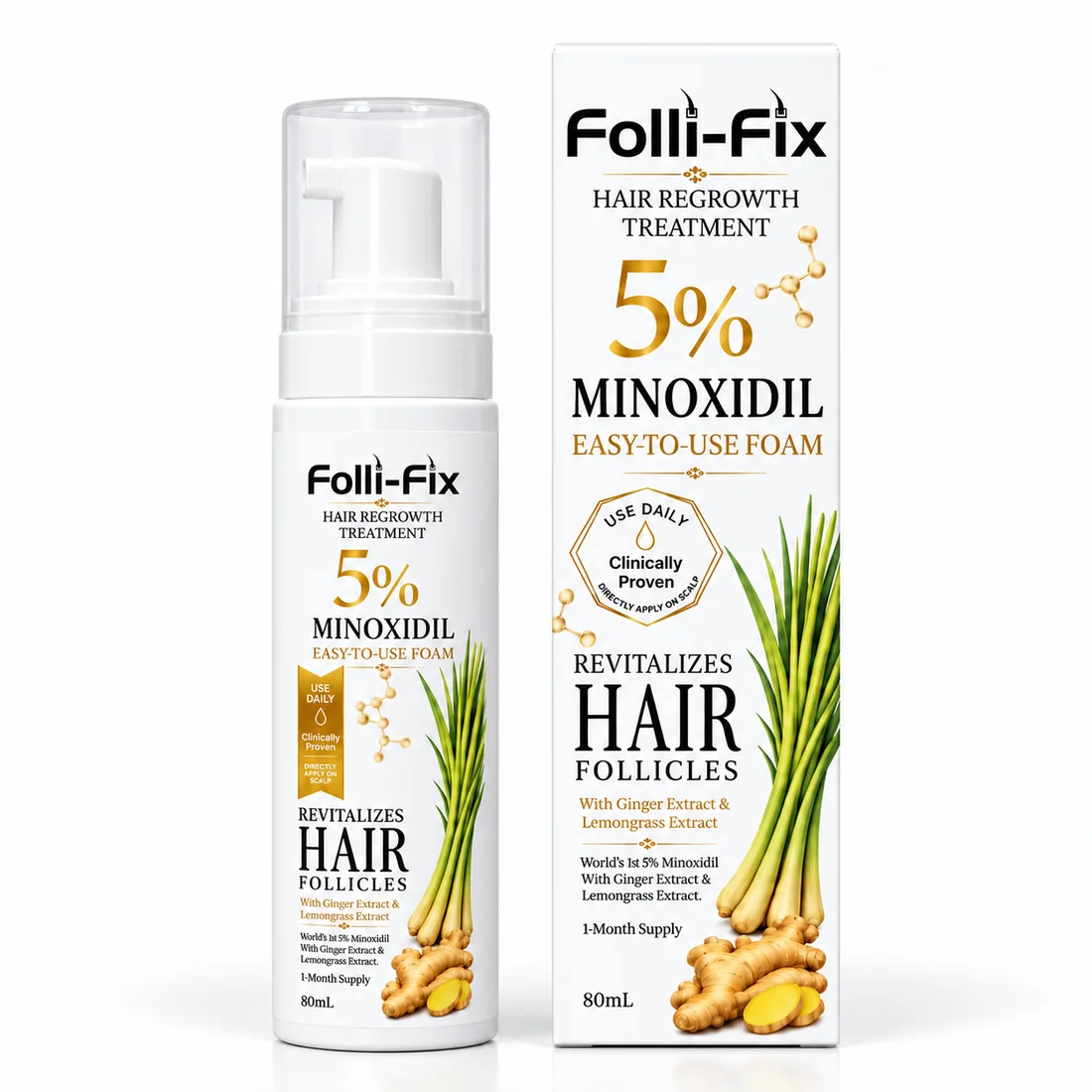
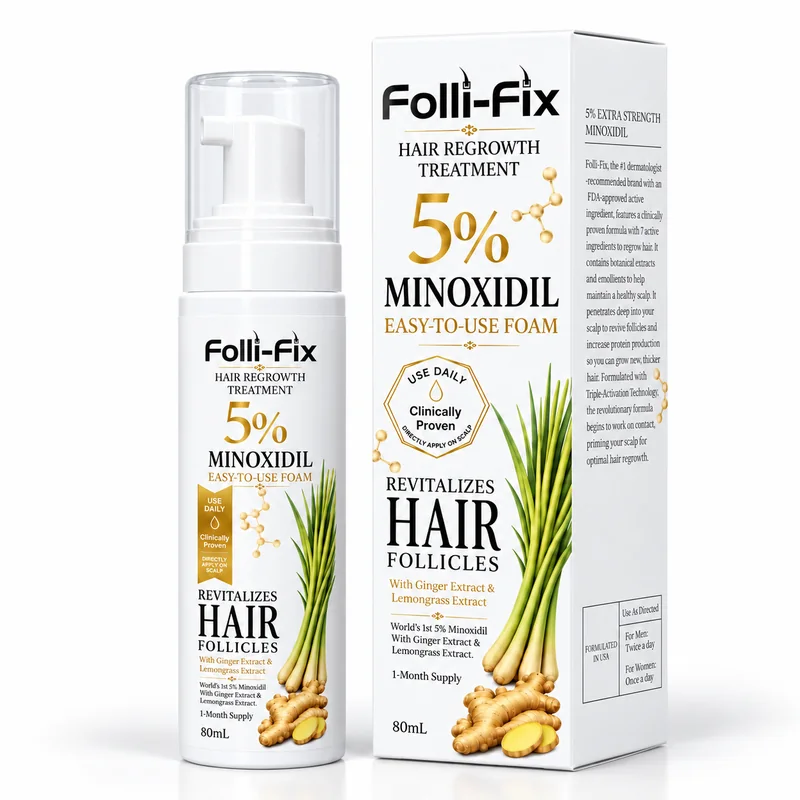
Folli-Fix bottle, three-quarter view
Folli-Fix bottle and box from above
022

Research

These are studies on ingredients or general approaches, summarised with their limits. None of them tested this treatment or product, and they don’t prove what it will do for you.

  1. Adil A, Godwin M. The effectiveness of treatments for androgenetic alopecia: a systematic review and meta-analysis. J Am Acad Dermatol 2017;77(1):136-141.Meta-analysis. Pooled trials found several approaches, including low-level light, did better than placebo for hair count. Trial quality was mixed.PubMed 28396101doi:10.1016/j.jaad.2017.02.054
  2. Messenger AG et al. (2004). Minoxidil: mechanisms of action on hair growth. Br J Dermatol 150(2):186-94.Narrative review (mechanism). Topical minoxidil shortens telogen and pushes resting follicles into anagen in animal studies, may prolong anagen and enlarge follicles; the potassium-channel mechanism remains unproven.PubMed 14996087doi:10.1111/j.1365-2133.2004.05785.x
  3. Mao QQ et al. (2019). Bioactive Compounds and Bioactivities of Ginger (Zingiber officinale Roscoe). Foods 8(6).Narrative review. Ginger's gingerols and shogaols show antioxidant, anti-inflammatory and antimicrobial activities in laboratory and clinical research.PubMed 31151279doi:10.3390/foods8060185
  4. Ayustaningwarno F et al. (2024). A critical review of Ginger's (Zingiber officinale) antioxidant, anti-inflammatory, and immunomodulatory activities. Front Nutr 11:1364836.Critical narrative review. Ginger and its compounds (gingerol, shogaol, paradol, zingerone) show strong antioxidant properties and potential to reduce inflammation, mainly via Nrf2 and NF-κB pathways.PubMed 38903613doi:10.3389/fnut.2024.1364836
  5. Wuthi-Udomlert M et al. (2011). Inhibitory effect of formulated lemongrass shampoo on Malassezia furfur: a yeast associated with dandruff. Southeast Asian J Trop Med Public Health 42(2):363-9.In vitro study. Lemongrass (Cymbopogon citratus) oil killed Malassezia furfur, a yeast associated with dandruff, and remained active when formulated into a shampoo.PubMed 21710859
  6. Donato R et al. (2020). Antifungal activity of different essential oils against Malassezia pathogenic species. J Ethnopharmacol 249:112376.Review. Many essential oils inhibit Malassezia species in vitro; two clinical studies used Cymbopogon (lemongrass) oils in shampoo, cream or lotion for dandruff and pityriasis versicolor.PubMed 31704415doi:10.1016/j.jep.2019.112376
  7. Chaisripipat W et al. (2015). Anti-dandruff Hair Tonic Containing Lemongrass (Cymbopogon flexuosus) Oil. Forsch Komplementmed 22(4):226-9.Randomised, double-blind, placebo-controlled split-head trial (30 adults). PubMed 26566122doi:10.1159/000432407
  8. Asghar F et al. (2020). Telogen Effluvium: A Review of the Literature. Cureus 12(5):e8320.Review. PubMed 32607303doi:10.7759/cureus.8320
  9. Lee WS et al. (2012). Characteristics of androgenetic alopecia in asian. Ann Dermatol 24(3):243-52.Narrative review (Asian patients). Review of androgenetic alopecia in Asian men and women; advises that a temporary, self-limiting shedding phase may occur in the first 2–8 weeks of minoxidil use and is not a reason to stop.PubMed 22879706doi:10.5021/ad.2012.24.3.243
  10. Suchonwanit P et al. (2019). Minoxidil and its use in hair disorders: a review. Drug Des Devel Ther 13:2777-2786.Narrative review. Irritant contact dermatitis is the most common side effect of topical minoxidil; minoxidil should be avoided in pregnancy and lactation; stopping treatment leads to shedding within 3–4 months.PubMed 31496654doi:10.2147/DDDT.S214907
  11. Kanti V et al. (2016). Effect of minoxidil topical foam on frontotemporal and vertex androgenetic alopecia in men: a 104-week open-label clinical trial. J Eur Acad Dermatol Venereol 30(7):1183-9.Randomised trial with 80-week open-label extension (104 weeks, men). PubMed 26387973doi:10.1111/jdv.13324
  12. McMullen E et al. (2025). Minoxidil toxicosis in cats and dogs: A scoping review and call to action. J Am Acad Dermatol 93(2):522-524.Scoping review (veterinary toxicology). Scoping review of minoxidil poisoning (toxicosis) in cats and dogs, calling for greater awareness of the risk of household exposure.PubMed 40189148doi:10.1016/j.jaad.2025.04.006
024

Related

Book a consultation

Start with a scalp check

Tell us a little about your hair. The form opens WhatsApp with your details filled in, ready to send to Dr Steven’s team.

  • Your scalp is checked before anything is recommended
  • Full price is explained before you decide, with no obligation
  • We serve you in English, 中文 or Bahasa Melayu

Prefer to message directly? WhatsApp 018-264 9747

WhatsApp↗