Copper tripeptide-1 (GHK-Cu)
Copper peptide
GHK-Cu is a small peptide (glycine, histidine and lysine) bound to copper. It occurs naturally in human plasma, and its levels fall with age. That is ingredient research, not a study of Folli-Flux.
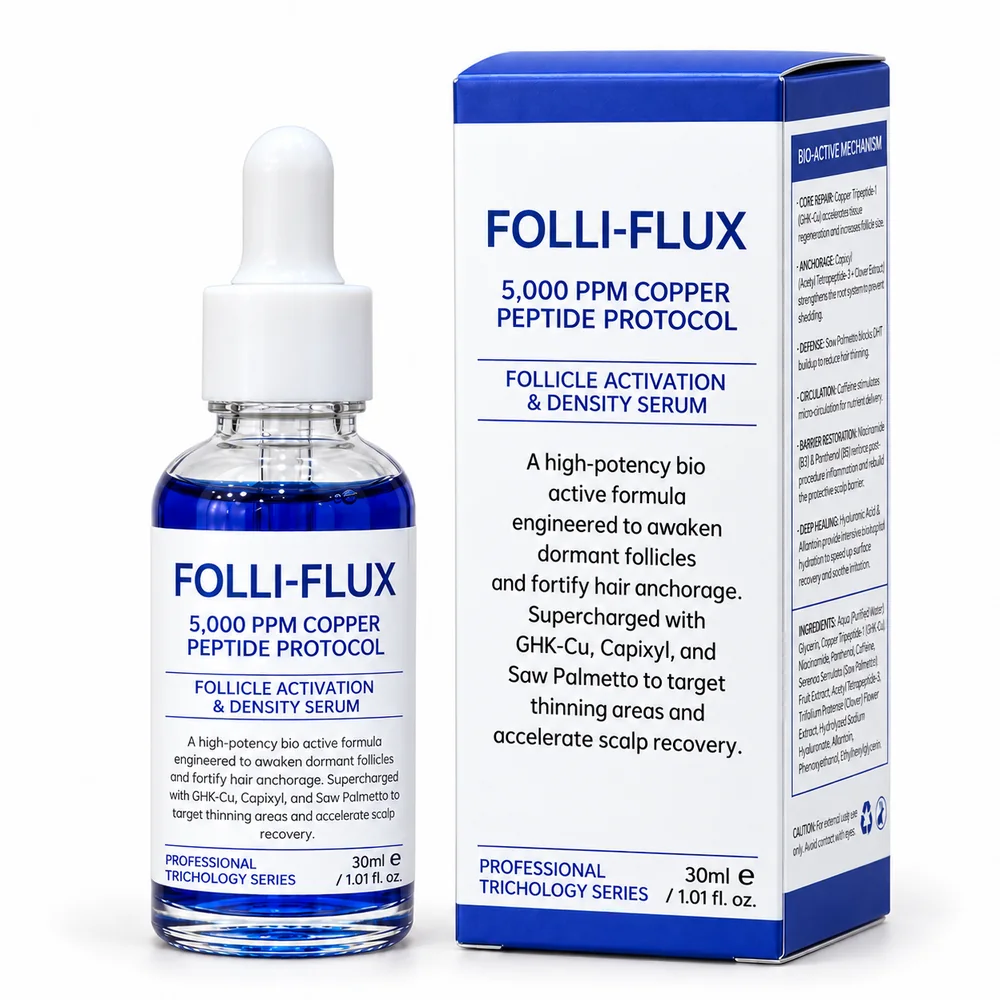
Copper Peptide Protocol: a leave-on scalp serum built around copper tripeptide-1 (GHK-Cu), with Capixyl and saw palmetto fruit extract, in a 30ml cobalt-blue dropper bottle.
RM129RM149Promo price
Shipping in Malaysia: RM20 West, RM30 East, added at checkout. Bundles of 3 ship free. Malaysia delivery only, no overseas orders.
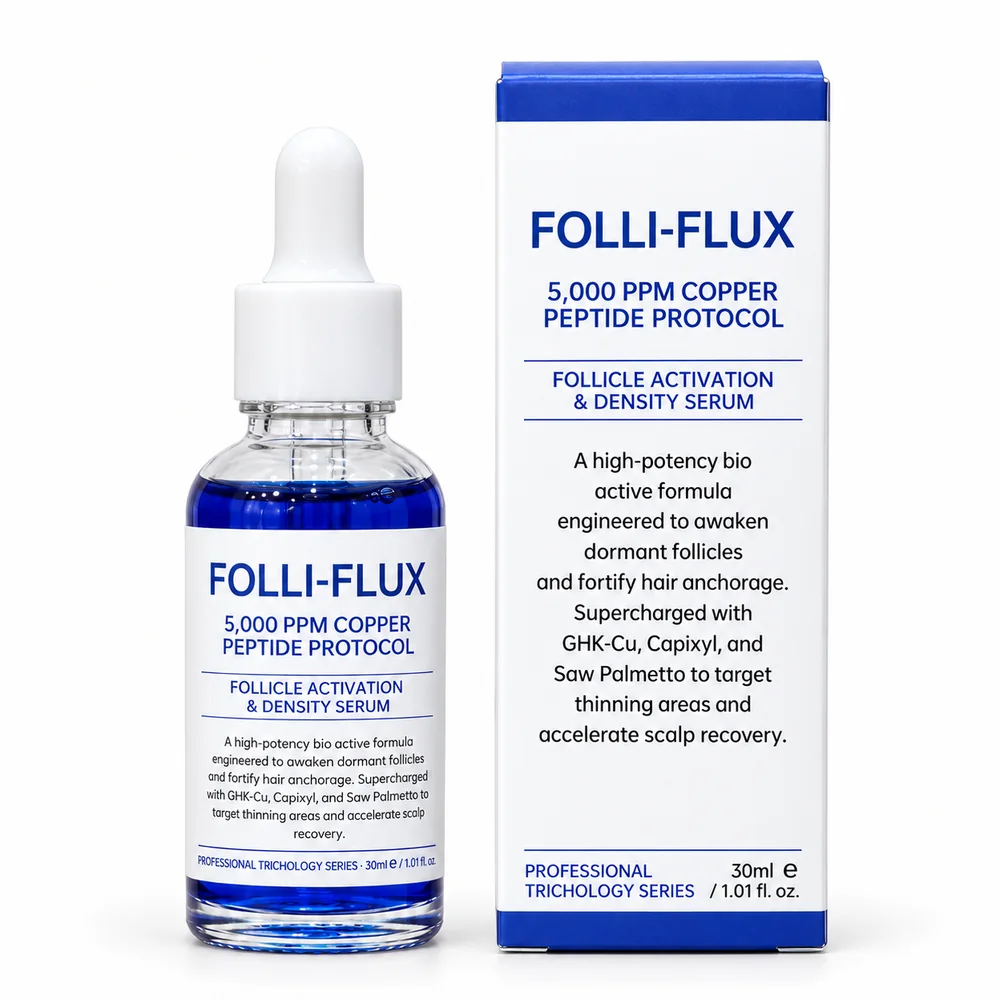
Folli-Flux is a leave-on scalp serum in a 30 ml cobalt-blue dropper bottle.
The formula is built around copper tripeptide-1 (GHK-Cu), with Capixyl (acetyl tetrapeptide-3 and red clover flower extract) and saw palmetto fruit extract, alongside caffeine, niacinamide (vitamin B3), panthenol (provitamin B5), hydrolysed hyaluronic acid and allantoin.
It is designed to be applied directly to the scalp over thinning areas, and the carton carries an official user protocol for pairing it with Dr.
Folli-Flux is a cosmetic scalp-care serum, not a medicine.
Copper peptide
GHK-Cu is a small peptide (glycine, histidine and lysine) bound to copper. It occurs naturally in human plasma, and its levels fall with age. That is ingredient research, not a study of Folli-Flux.
Peptide and botanical complex
Capixyl is a trade-name cosmetic complex that pairs a biomimetic peptide, acetyl tetrapeptide-3, with an extract of red clover (Trifolium pratense) flowers. A small randomised, placebo-controlled study tested a topical combination of these two ingredients over four months [1]. That study used its own formula, so it is not a result for Folli-Flux.
Botanical extract
An extract of the fruit of the saw palmetto palm, a botanical that appears in many hair-care formulas. A systematic review of mostly small studies found the evidence for saw palmetto products in hair loss encouraging but limited, and called for better-quality trials [2].
Plant alkaloid
The familiar alkaloid from coffee and tea, widely used in scalp and hair-care products.
Vitamins B3 and provitamin B5
Niacinamide is a form of vitamin B3 and panthenol is the provitamin of vitamin B5. Both are long-standing skin-care ingredients used in formulas for scalp comfort and the skin barrier.
Vitamins B3 and provitamin B5
Hydrolysed sodium hyaluronate is a smaller-fragment form of hyaluronic acid, a moisture-binding ingredient that is well tolerated on skin4. Glycerin is a classic humectant, and allantoin is a skin-conditioning ingredient known for its soothing feel.
Hydration and comfort
Hydrolysed sodium hyaluronate is a smaller-fragment form of hyaluronic acid, a moisture-binding ingredient that is well tolerated on skin [3]. Glycerin is a classic humectant, and allantoin is a skin-conditioning ingredient known for its soothing feel.
As printed on the carton
Aqua (Purified Water), Glycerin, Copper Tripeptide-1 (GHK-Cu), Niacinamide, Panthenol, Caffeine, Serenoa Serrulata (Saw Palmetto) Fruit Extract, Acetyl Tetrapeptide-3, Trifolium Pratense (Clover) Flower Extract, Hydrolyzed Sodium Hyaluronate, Allantoin, Phenoxyethanol, Ethylhexylglycerin.
As printed on the carton
Start with a clean, dry scalp.
Apply 1–2 ml of Folli-Flux directly to the scalp over the areas you want to target.
Leave it on. Do not rinse.
How often: Twice daily, morning and night.
Capixyl is a trade-name cosmetic complex that pairs a biomimetic peptide, acetyl tetrapeptide-3, with an extract of red clover (Trifolium pratense) flowers. A small randomised, placebo-controlled study tested a topical combination of these two ingredients over four months2. That study used its own formula, so it is not a result for Folli-Flux.
Folli-Flux is a leave-on serum that becomes part of your daily scalp routine.
Folli-Flux is a cosmetic scalp-care serum and does not treat hair loss. Hair grows slowly, and results vary from person to person.
Apply 1–2 ml directly to a clean, dry scalp, twice daily (morning and night).
Yes. The carton carries the official user protocol for Dr.
No. Folli-Flux is a cosmetic scalp-care serum, not a medicine. If your hair loss is sudden, patchy or worrying, please see a doctor.
GHK-Cu (copper tripeptide-1) is a small copper-binding peptide that occurs naturally in the body. Research on it is mostly laboratory and animal work1.
Scalp serum · 30ml
Copper peptides, in focus.
Concept artwork. For the product itself, see the photo above.
Source: drstevengoh.com
Pickart L et al. · Biomed Res Int · 2015
Randomised, placebo-controlled trial (30 volunteers)
Loing E et al. · J Cosmet Sci · 2013
Systematic review (5 RCTs, 2 cohort studies)
Evron E et al. · Skin Appendage Disord · 2020
Review + RCT summary
Bravo B et al. · Dermatol Ther · 2022
General information only, not medical advice. Speak to a qualified professional about your own scalp and hair.
Source: drstevengoh.com
Scalp gel · 10ml
Hyaluronic acid scalp moisture gel in a precision syringe. 10ml.
Promo RM99 (usual RM129)View detailsMen's liquid, dropper · 60ml
Source: drstevengoh.com
Capixyl is a trade-name cosmetic complex that pairs a biomimetic peptide, acetyl tetrapeptide-3, with an extract of red clover (Trifolium pratense) flowers. A small randomised, placebo-controlled study tested a topical combination of these two ingredients over four months1. That study used its own formula, so it is not a result for Folli-Flux.
An extract of the fruit of the saw palmetto palm, a botanical that appears in many hair-care formulas. A systematic review of mostly small studies found the evidence for saw palmetto products in hair loss encouraging but limited, and called for better-quality trials2.
Hydrolysed sodium hyaluronate is a smaller-fragment form of hyaluronic acid, a moisture-binding ingredient that is well tolerated on skin3. Glycerin is a classic humectant, and allantoin is a skin-conditioning ingredient known for its soothing feel.
Start with a clean, dry scalp.
Leave it on. Do not rinse.
Twice daily, morning and night.
RM129 · Buy 3 bundle RM387, free Malaysia shipping (single items: RM20 West / RM30 East shipping)
It combines copper tripeptide-1 (GHK-Cu), Capixyl (acetyl tetrapeptide-3 with red clover flower extract) and saw palmetto fruit extract with caffeine, niacinamide, panthenol, hyaluronic acid and allantoin.
GHK-Cu (copper tripeptide-1) is a small copper-binding peptide that occurs naturally in the body. Research on it is mostly laboratory and animal work4.
Caviar has long been a symbol of luxury on the plate. More recently, scientists have become interested in what sturgeon roe and other marine materials can do for skin and hair. Rich in proteins, peptides and omega-3 fatty acids, marine extracts are now among the most researched 'beauty-from-the-sea' ingredients. Here is what the science shows, and how strong that evidence really is.
Caviar is sturgeon roe (fish eggs). Its extracts contain phospholipids, including the omega-3 fatty acid docosahexaenoic acid (DHA), as one of the main components. When caviar is enzyme-treated, its proteins are broken down into mainly low-molecular-weight peptides made of amino acids such as leucine, tyrosine and phenylalanine.
Caviar is used both as a nutritional food and in cosmetic products.
The most robust caviar study to date is a randomised, double-blind, placebo-controlled clinical trial. Participants taking an oral enzyme-treated caviar extract showed significant improvements in skin hydration, dermal hydration and transepidermal water loss after four weeks, and in skin elasticity after eight weeks.
Laboratory and animal research helps explain why:
For a scalp exposed to tropical sun, antioxidant and hydration support is a sensible goal. But note: these are skin studies, and the human trial used an oral extract.
We found no published studies testing caviar extract directly on human hair growth. The closest evidence comes from related marine ingredients:
These trials are encouraging for marine-derived nutrition in general. They are not evidence for any specific topical caviar product, and we will not pretend otherwise.
Peptides are short chains of amino acids. Some act as messengers that tell cells what to do, which is why they are widely used in skincare.
Peptide research is promising, but results depend on the specific peptide, its concentration and its delivery. 'Peptides' on a label does not tell you which ones.
Marine ingredients are often marketed with sweeping promises. A few questions keep things honest:
Marine ingredients are natural, but natural does not mean allergy-free.
The research above was not conducted on Folli-Fuel. We include caviar and peptides for their skin-hydration and antioxidant research, and we are clear that direct hair studies on caviar do not yet exist.
Folli-Fix (foam, for men and women) and Folli-Fix X10 (liquid, for adult men) are our minoxidil treatments; use one or the other on a given area, not both. Folli-Care is our hyaluronic-acid scalp hydrator. Folli-Fuel is a professional in-centre treatment delivered by our experienced team. Ask us to help you choose a routine that suits your scalp and goals.
It has not been tested directly on hair growth. Caviar extract improved skin hydration and elasticity in a randomised oral trial and showed antioxidant effects in the lab, but no human hair studies exist yet.
Clinical trials suggest they can. Two randomised, placebo-controlled trials in women found more terminal hairs or thicker fine hairs and reduced shedding.
Some act as cell messengers. Copper peptides support skin repair and stimulated human hair follicle elongation in the lab.
Talk to your doctor first. Fish roe allergy, including anaphylaxis, has been reported even in people without a general fish allergy.
In laboratory and mouse studies, fish-oil DHA increased dermal papilla cell proliferation and promoted the growth phase. Human evidence is still limited.
Not necessarily. Evidence depends on the specific ingredient and study, not on its source; each should be judged on its own research.
Great hair starts at the scalp. Yet most routines are designed around the hair shaft: shampoo, conditioner, styling. A scalp care routine flips the focus to the skin your hair grows from. The good news is that it does not need to be complicated. It needs to be consistent, matched to your goals, and based on what research actually supports.
The scalp is skin with an unusually dense population of hair follicles. When it is irritated, flaky or inflamed, hair suffers. Over 20 epidemiological studies associate abnormal scalp conditions with impaired hair, and a treatment study showed those effects on hair were reversible once the scalp was normalised. Scientists describe oxidative stress as the mechanism linking an unhealthy scalp to poorer hair growth and retention.
So a scalp routine is not a luxury. It is the foundation.
Before choosing products, decide what you are trying to achieve:
Sudden patchy loss, scarring, pain or significant redness are reasons to see a doctor first.
Many people under-wash because they fear washing will make hair fall out. Research says otherwise. In a study of Asian populations, washing five to six times a week gave the best overall scalp and hair satisfaction, and daily washing outperformed weekly washing with no detrimental effects.
Hairs released during washing are mostly resting (telogen) hairs that had already reached the end of their cycle; clinicians even count them in a standardised hair-wash test.
If you have dandruff, use an anti-dandruff shampoo. Dandruff is linked to Malassezia yeasts and responds to treatments that inhibit them, and improving dandruff has been shown to reduce scalp oxidative stress and improve the quality of hair grown afterwards.
Conditioners are formulated for the hair shaft. The scalp needs its own lightweight hydration. Hyaluronic acid is a well-tolerated, hygroscopic ingredient supported by multiple clinical studies for skin hydration, which makes it a natural choice for a scalp hydrator.
Apply hydrating products to clean, dry scalp, section by section, and massage in.
A meta-analysis of randomised trials found it superior to placebo in both sexes.
To get the most from a minoxidil product:
A simple layering principle: treatment first, on a dry scalp; hydration and styling after it has absorbed. If you use a minoxidil product and a scalp gel, apply them at different times of day if possible, or follow your product instructions carefully so each one can do its job.
Massage helps distribute products and is a pleasant habit. In a small study of nine healthy men, four minutes of standardised scalp massage daily for 24 weeks was associated with increased hair thickness. These are small or self-reported studies, so think of massage as a supporting habit, not a treatment.
UV radiation is the most frequent cause of structural damage to the hair shaft: UVB degrades hair proteins and UVA changes colour. Solar radiation can reduce hair strength, lustre and protein content. A hat or shade during the strongest midday sun protects both scalp and hair.
Hair is built from what you eat. Iron, zinc, vitamin D and B vitamins all play roles in the hair follicle cycle, and deficiency may be a modifiable risk factor for hair loss. If you suspect a deficiency, ask your doctor for a blood test before supplementing.
Be cautious with megadoses. Supplements without a documented deficiency have unproven benefit, and some may worsen hair loss. Biotin is a good example: reported benefits occur in people with an underlying deficiency, and high-dose biotin can distort common blood tests, including thyroid tests. Tell your doctor if you take it.
Lifestyle matters too. In a population study of Asian men, smoking was significantly associated with more severe pattern hair loss.
Hair grows in cycles that span months to years, so daily mirror checks will only frustrate you. Take photos in the same light, from the same angles, once a month. Judge a hair-loss treatment after at least four months of consistent use.
Most people can wash often. Among Asian participants, five to six washes a week gave the best results, and daily washing outperformed weekly washing.
No. Daily washing showed no detrimental effects in a study of Asian populations, and hairs shed while washing are mostly resting hairs at the end of their cycle.
Dry. Apply minoxidil to a dry scalp on the thinning areas and wash your hands afterwards, as product directions advise.
Usually, yes, with good timing. Apply the minoxidil treatment to a dry scalp first, let it absorb, and follow each product's directions.
It may help a little. Small studies linked daily massage to thicker hair, but they were small or self-reported.
Comfort improves quickly; hair takes months. For minoxidil, results may take two to four months or more.
Only if you are deficient. Correcting a deficiency matters, but supplementing without one has unproven benefit.
These are studies on ingredients or general approaches, summarised with their limits. None of them tested this treatment or product, and they don’t prove what it will do for you.
Tell us a little about your hair. The form opens WhatsApp with your details filled in, ready to send to Dr Steven’s team.
Prefer to message directly? WhatsApp 018-264 9747