Answer first
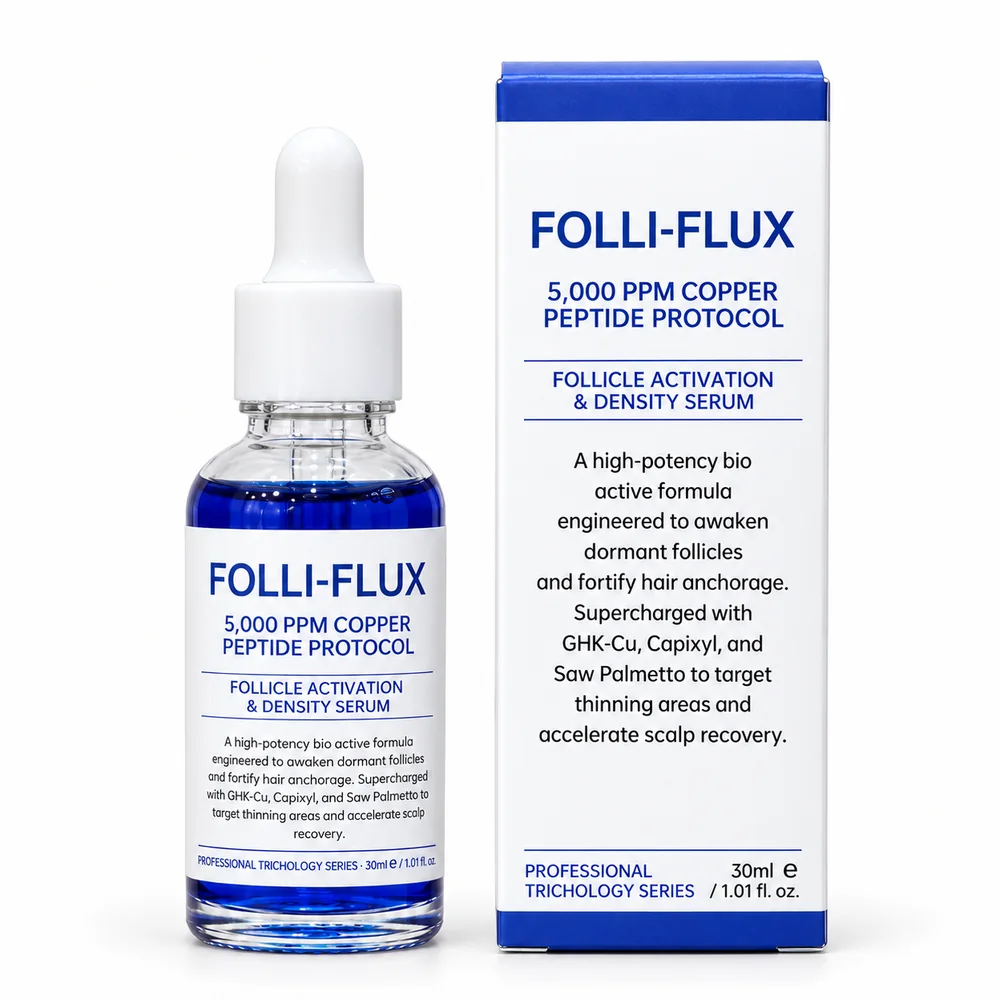
GHK-Cu is a small copper-binding peptide found naturally in the body. Lab and animal studies have examined its effects on skin and on hair-follicle cells, and reviews discuss it as a cosmetic ingredient. These are studies on the ingredient, not proof of what Folli-Flux does for any one person.
What's been studied
Cell studies looked at follicle cells; reviews summarise skin-repair and cosmetic research.
Reading it fairly
Lab results don't automatically translate to people. Use a serum as part of a sensible routine.
Questions
Is GHK-Cu a drug?
In Folli-Flux it is a cosmetic ingredient.
Why is the serum blue?
Copper peptides naturally have a blue tint.
Studies mentioned
These studies looked at ingredients or general approaches. None of them tested our treatments or products, so they are background, not proof.
- Pickart L et al. (2015). GHK Peptide as a Natural Modulator of Multiple Cellular Pathways in Skin Regeneration. Biomed Res Int 2015:648108.Review. The copper peptide GHK-Cu, naturally present in plasma and declining with age, supports skin repair, collagen and glycosaminoglycan synthesis, and wound healing including of hair follicles in animal studies.PubMed 26236730doi:10.1155/2015/648108
- Pyo HK et al. (2007). The effect of tripeptide-copper complex on human hair growth in vitro. Arch Pharm Res 30(7):834-9.Ex vivo human follicle + cell study. The tripeptide-copper complex AHK-Cu stimulated elongation of human hair follicles ex vivo and proliferation of dermal papilla cells.PubMed 17703734doi:10.1007/BF02978833
- Uno H et al. (1993). Chemical agents and peptides affect hair growth. J Invest Dermatol 101(1 Suppl):143S-147S.Animal studies review. A copper-binding peptide enlarged hair follicles in fuzzy rats with an effect similar to topical minoxidil.PubMed 8326148doi:10.1111/1523-1747.ep12363275